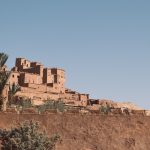
Ait Ben Haddou is the earthen ksar (fortified village) on the old caravan road between the Sahara and Marrakech, about 180 km from Marrakech over the High Atlas and 30 km from Ouarzazate. It’s a UNESCO World Heritage Site, a working film set for everything from Lawrence of Arabia to Gladiator and Game of Thrones, and the first big stop on almost every trip from Marrakech to the desert. Entry to the village itself is free. Below, our guides explain how to get there, what to see, what it costs and how to fit it into your trip.
Quick facts: Ait Ben Haddou
- What it is: a ksar, a cluster of mud-brick kasbahs and houses behind a defensive wall, climbing a hill above the Ounila river.
- Where: Ouarzazate province, on the southern side of the High Atlas.
- From Marrakech: about 180 km, 3.5–4 hours by road over the Tizi n’Tichka pass (2,260 m).
- From Ouarzazate: about 30 km, roughly 30 minutes.
- UNESCO listing: 1987.
- Entry: no official ticket for the village. Some houses and small museums inside ask about 20–50 MAD.
- Time needed: 1.5–3 hours on site.
- Best light: late afternoon and sunset, after the midday tour buses leave.
- Best months: March–May and late September–November.
- Easiest way to visit: on a multi-day trip south from Marrakech, with the ksar as the first stop.
What is Ait Ben Haddou?
A ksar (plural ksour) is a fortified village: a group of family houses, granaries and kasbahs packed together inside one wall, built for defence on the trade routes of the south. Ait Ben Haddou is the best-preserved example in Morocco and the reason UNESCO listed it in 1987 as an example of the earthen architecture of the pre-Saharan valleys.
The walls are made of pisé (rammed earth) and mud brick, mixed with straw and laid on stone foundations. Rain slowly washes them away, so they need constant repair. Most of the buildings you see today date from the 17th century onwards, but the site has guarded this crossing for much longer. Caravans carrying salt, gold, dates and slaves passed through on their way between the Sahara and Marrakech, and the families of the ksar grew rich controlling the route.
Today very few families still live inside. Most moved across the river to the newer village in the 20th century, where there’s water, electricity and road access. What remains is part living village, part open-air museum, part film set. The September 2023 Al Haouz earthquake damaged some buildings in the region, and you may see repair work and scaffolding on parts of the ksar.

Ait Ben Haddou in films: Gladiator, Game of Thrones and more
Ait Ben Haddou’s second career is in the cinema. The studios of nearby Ouarzazate have used it for decades, partly because the ksar can play almost any ancient city in the Middle East or the Mediterranean. Films and series shot here include:
- Lawrence of Arabia (1962)
- Jesus of Nazareth (1977)
- The Jewel of the Nile (1985)
- The Living Daylights (1987)
- The Mummy (1999)
- Gladiator (2000), where the ksar stood in for the slave market and arena town of Zucchabar
- Alexander (2004)
- Prince of Persia: The Sands of Time (2010)
- Game of Thrones, where it became Yunkai, one of the slaver cities Daenerys frees in season 3
Your guide will point out where scenes were shot, and in the new village you’ll see film posters in nearly every café. If you’re a film fan, add a stop at the Atlas Studios in Ouarzazate (more below).
How to get to Ait Ben Haddou
There’s no train south of Marrakech, so you’ll reach Ait Ben Haddou by road. Your options, from easiest to hardest:
| Option | Time from Marrakech | Good for | Downsides |
|---|---|---|---|
| Small-group tour south (2–3+ days) | First stop on day 1 | Seeing the ksar, the valleys and the desert in one trip | Fixed dates and route |
| Day trip from Marrakech | 3.5–4 h each way | Short trips with no time for the south | 7–8 hours in a vehicle for 1.5–2 hours on site |
| Self-drive | 3.5–4 h | Confident drivers who want flexibility | Mountain hairpins, trucks, checkpoints |
| Bus to Ouarzazate + taxi | About 5 h by bus, then 30 min | Tight budgets | No direct bus; grand taxis leave only when full |
The road over the Tizi n’Tichka pass
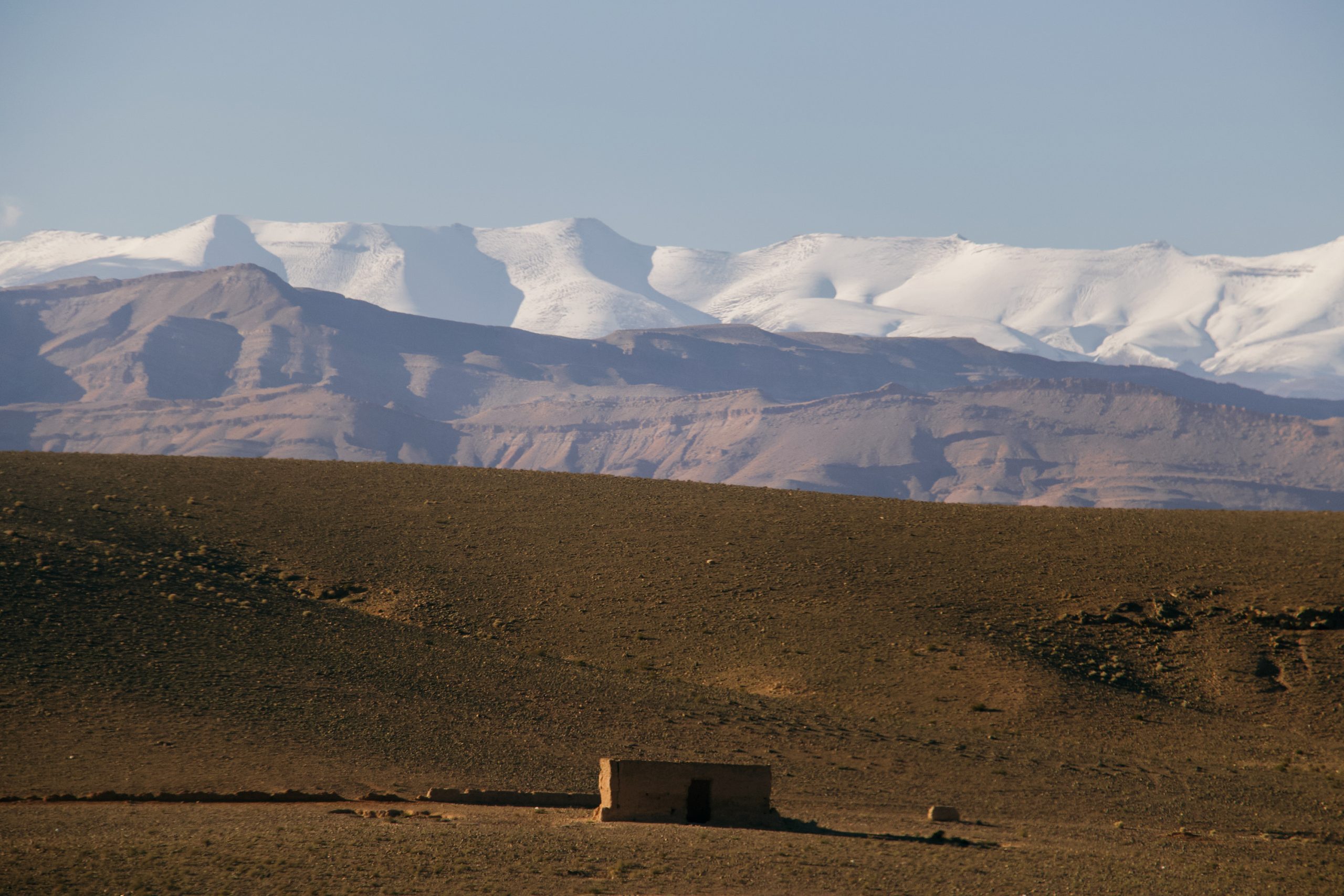
The N9 from Marrakech climbs through the High Atlas to the Tizi n’Tichka pass at 2,260 metres, one of the highest road passes in Morocco, then drops towards Ouarzazate. The road has been widened and is in good condition, but it’s still a mountain road: long hairpins, slow trucks, and snow and ice at the top on some winter days. Allow 3.5–4 hours to Ait Ben Haddou with a coffee stop, longer if you stop for photos (you will).
Most guides stop at a roadside café in the foothills, then at a viewpoint near the pass, where stalls sell fossils and minerals. On the descent, keep your eyes open for Berber villages built from the same red earth as the hillside, almost invisible until you’re close.
The Telouet detour
Just after the pass, a side road leads east to Telouet, the old seat of the Glaoui family, who controlled this route and much of southern Morocco in the early 20th century. Their kasbah is half ruin, but the restored reception rooms inside have some of the finest painted ceilings and zellige tilework in the country. From Telouet, a scenic road runs down the Ounila Valley past oases and smaller ksour, arriving at Ait Ben Haddou from the north. It adds a couple of hours to the day and is worth it if you aren’t in a hurry.
Ait Ben Haddou day trip from Marrakech: is it worth it?
An Ait Ben Haddou day trip from Marrakech is popular and you’ll see dozens of minibuses doing it. It works if you only have a few days in Morocco and won’t go further south. But be realistic: you’ll spend 7–8 hours on the road and arrive in the middle of the day, when the light is flat and the alleys are at their busiest.
Our honest advice: if you have three days or more, don’t do Ait Ben Haddou as a day trip. Make it the first stop on a trip to the desert instead. You see the same ksar on the same road, but the drive takes you somewhere new (the Dades Valley, the Todgha Gorge, the Sahara) rather than straight back to Marrakech. That’s exactly what our 3-day small-group desert tour from Marrakech does.
By bus and taxi
There’s no direct public bus to Ait Ben Haddou. Take a CTM or Supratours bus from Marrakech to Ouarzazate (about 5 hours), then a grand taxi or a hired car for the last 30 km. Shared grand taxis leave when all six seats are full, which can mean waiting. This works best if you’re staying a night in Ait Ben Haddou or Ouarzazate rather than coming back the same day.
What to see in Ait Ben Haddou
Crossing the river
The new village, with its car parks, cafés and hotels, sits on one side of the Ounila river; the old ksar is on the other. For most of the year the riverbed is almost dry and you cross on a pedestrian bridge or stepping stones. After heavy rain the water can rise, and that’s when the stepping stones (and sometimes a mule ride) come into play. The view of the ksar from the riverbank is one of the classic photos, so don’t rush across.
The alleys and houses
Inside the walls, a path winds up through narrow lanes, covered passages and stairways between the houses. Many are empty, some are being restored, and a few are still lived in or turned into small shops and galleries. Look for:
- The defensive towers on the corners of the larger kasbahs, decorated near the top with geometric patterns cut into the mud.
- Traditional houses you can step inside, with ground floors for animals and storage and living rooms upstairs. Owners usually ask a small fee or tip.
- Painters who use saffron, tea and indigo, then hold the paper over a flame to reveal the image. It’s a fun demonstration, and there’s no obligation to buy.
- The old public square and mosque area near the lower part of the ksar.

The climb to the granary (agadir)
At the very top of the hill stand the ruins of the agadir, the fortified granary where the village once stored its harvest and valuables, and the last place to retreat to under attack. The climb from the river takes about 15–20 minutes at an easy pace, on uneven steps and gravel paths, so wear proper shoes. The building itself is mostly ruin. You go for the view: the whole ksar below you, the green ribbon of the Ounila river, the stony desert plain to the south and, on clear days, the snow on the High Atlas to the north.
Local tip: go up first and wander down afterwards. You’ll climb while you’re fresh, see the layout of the ksar from above, and then explore the lanes knowing where you are.

Ait Ben Haddou entrance fee and costs
The ksar has no gate and no official ticket. It’s a village, not a monument with opening hours. What you’ll actually spend money on:
| Item | Typical cost |
|---|---|
| Entering the ksar | Free (a few houses at the main entrance sometimes ask about 20 MAD to pass through; another route is free) |
| Visiting a traditional house or small museum inside | About 20–50 MAD |
| Local guide inside the ksar | Agree the price first; included on organised tours |
| Kasbah Taourirt, Ouarzazate | 20 MAD |
| Atlas Studios, Ouarzazate (guided tour) | About 80 MAD; more with extra sets |
| Cinema Museum, Ouarzazate | About 30 MAD |
| Lunch in the new village | Tourist-menu prices, higher than local cafés in town |
Prices are what we and other recent visitors have seen and can change; carry small notes in dirhams. Roughly 10–11 MAD makes one euro.
Best time to visit Ait Ben Haddou
Time of day
Day-trip minibuses from Marrakech arrive from late morning and leave by mid-afternoon. If you can, come early in the morning or after about 3 pm. Late afternoon is best: the walls turn from beige to deep orange, the lanes empty out and the agadir becomes the best sunset viewpoint in the area. That’s only realistic if you sleep nearby or are on a multi-day trip that’s continuing south.
Season
- Spring (March–May): green fields along the river, almond blossom early in the season and comfortable walking temperatures.
- Autumn (late September–November): warm days, clear light, the date harvest in the oases.
- Winter (December–February): sunny, mild days around 15–20°C, but cold mornings and nights, and snow possible on the Tichka pass.
- Summer (June–August): temperatures often pass 40°C. Visit early and drink a lot of water.
Our guide to the best month to visit Morocco covers the whole country month by month.
Ouarzazate: the town next door
Thirty minutes south, Ouarzazate is the main town of the region and the base of Morocco’s film industry. It’s not a beautiful town, but it has three worthwhile stops if you have a spare afternoon:
- Atlas Studios, about 5 km west of the centre on the Marrakech road. Guided tours run through sets built for international productions, including Kingdom of Heaven. Open from about 8:30 am until sunset.
- Kasbah Taourirt, a former Glaoui kasbah in the town centre, with painted rooms and a maze of courtyards.
- The Cinema Museum, opposite Kasbah Taourirt, full of props and old sets.
Ouarzazate is also the gateway to the Draa Valley to the south and the road east through Skoura and the Valley of Roses towards the Dades Valley.

Where to stay in Ait Ben Haddou
Sleeping here is the best way to see the ksar at sunset and first light. Most places to stay are family-run guesthouses and small kasbah hotels in the new village, many with terraces facing the ksar, and some with pools for the hot months. There are also a few rooms inside the old ksar itself for a more atmospheric (and simpler) stay. On our multi-day tours, the first night is usually further on, in the Dades Valley, so the ksar is a long afternoon stop rather than an overnight.
Ait Ben Haddou on a Morocco itinerary
Ait Ben Haddou fits naturally into almost any route through the south. A few ways our guests do it:
- 3 days, Marrakech to the Sahara and back: Day 1 over the Tichka pass to Ait Ben Haddou, then on to the Dades Valley. Day 2 through the Todgha Gorge to the Erg Chebbi dunes at Merzouga for a camel ride and a night in camp. Day 3 back to Marrakech. This is our 3-day desert tour from Marrakech to Merzouga.
- 5 days: the same loop with an extra night, or Marrakech plus the desert. See our 5-day Morocco itinerary for three routes.
- One week: the imperial cities in the north, the Sahara, then Ait Ben Haddou on the way into Marrakech. Our 7-day Morocco itinerary lays it out day by day.
- Two weeks: add the Atlantic coast and more time in the valleys, as in our 2-week Morocco itinerary.
Why see Ait Ben Haddou on a small-group tour
You can visit Ait Ben Haddou on your own, but most of our guests see it as part of a small group, for good reasons:
- The road is done for you. No hairpins, no hire-car insurance questions, no searching for parking in the new village.
- It’s part of a bigger trip. The ksar becomes the first stop on the way to the gorges and the Sahara, not a long round trip back to Marrakech.
- A guide who knows the place. You’ll hear the story of the caravans, the Glaoui and the film shoots, find the quieter lanes and skip the persistent sellers.
- Shared costs. A vehicle and driver for the south cost the same for one person as for several. Sharing it with a small group brings the price down.
- Good company. Lunch on a terrace facing the ksar and the evening in the Dades Valley are better with fellow travellers, especially if you’re travelling solo. See our advice on solo travel in Morocco.

Practical tips for visiting Ait Ben Haddou
- Wear good shoes. The paths to the top are steep, uneven and slippery with gravel.
- Bring water, a hat and sunscreen. There’s little shade on the upper part of the hill.
- Carry small change. Entrance to houses, tips and small purchases are all in cash, and change is often short.
- Ask before photographing people. Some residents and artisans are happy to pose, some expect a tip, and some prefer not to be photographed.
- Agree prices first for unofficial guides, mule rides across the river and house visits.
- Dress for sun and modesty. Light, loose layers covering shoulders and knees. Our Morocco packing list has the details, including warm layers for the Tichka pass in winter.
- Respect the walls. Don’t climb on crumbling sections; the earth is fragile and repairs are expensive.
Join a small-group tour through Ait Ben Haddou
These trips all stop at Ait Ben Haddou on the way south, with an English-speaking guide and fixed departure dates:
- 3-Day Desert Tour from Marrakech to Merzouga (Small Group): Ait Ben Haddou, the Dades Valley, the Todgha Gorge and a night in the Erg Chebbi dunes. See dates and prices.
- Southern Morocco Discovery: a slower trip through the kasbahs, oases and valleys of the south.
- Sahara Desert Tours Morocco: more time in the dunes, with the ksar on the route.
- Morocco Desert Tour and the High Atlas Mountains: the Atlas, the kasbah road and the Sahara in one loop.
- The Highlights of Morocco Tour: the imperial cities, the Sahara and Ait Ben Haddou on the way into Marrakech.
Prefer your own dates? Every tour can also be booked as a private trip.
See all Morocco group tours and dates
Ait Ben Haddou: frequently asked questions
Is Ait Ben Haddou worth visiting?
Yes. It’s the best-preserved ksar in Morocco, a UNESCO site and one of the most photographed places in the country. It’s most rewarding as a stop on the way south to the valleys and the Sahara, rather than as a long day trip there and back from Marrakech.
Is there an entrance fee for Ait Ben Haddou?
No, the village itself is free to enter. Some households near the main entrance occasionally ask around 20 MAD to pass through their property, and houses or small museums inside typically ask 20–50 MAD to look around.
How far is Ait Ben Haddou from Marrakech?
About 180 km, which takes 3.5–4 hours by road over the Tizi n’Tichka pass, plus stops. It’s around 30 km, or 30 minutes, from Ouarzazate.
Can you do Ait Ben Haddou as a day trip from Marrakech?
You can, and many tours do, but expect 7–8 hours of driving for 1.5–2 hours at the ksar. If you have three days, a trip that continues to the Dades Valley and the Sahara makes far better use of the drive.
Which films were shot at Ait Ben Haddou?
Among many others: Lawrence of Arabia, The Mummy, Gladiator, Alexander, Prince of Persia and the TV series Game of Thrones, where it played the city of Yunkai.
How long do you need at Ait Ben Haddou?
Allow at least 1.5 hours to cross the river, climb to the granary and walk back through the lanes. Two to three hours lets you go slowly, visit a house and have lunch facing the ksar.
Do people still live in Ait Ben Haddou?
Only a handful of families still live inside the old ksar. Most residents moved across the river to the new village, but many still work in the ksar, running shops, galleries and guesthouses.
What’s the best time of day to visit Ait Ben Haddou?
Early morning or late afternoon. Day-trip groups crowd the lanes around midday, while the late-afternoon light turns the walls deep orange and the agadir at the top is the area’s best sunset viewpoint.