The best 10-day Morocco itinerary for a first trip runs one way from Casablanca to Marrakech: Rabat, two nights in the blue town of Chefchaouen, Volubilis and Meknes, two nights in Fes, a night in the Sahara at Merzouga, the Dades Valley and Aït Ben Haddou, then three nights in Marrakech with a last day in the High Atlas or on the coast at Essaouira. Ten days is the length where Morocco stops feeling rushed: you get the north, the imperial cities and the desert, with a rest day built in. Below is the route day by day as our guides run it, with drive times, what to see, what it costs, and two alternative 10-day routes.
Quick facts: 10 days in Morocco
- Route: Casablanca → Rabat → Chefchaouen → Volubilis → Fes → Merzouga (Sahara) → Dades Valley → Aït Ben Haddou → Marrakech.
- Total driving: roughly 1,900 km over 10 days; no day longer than the Fes–Merzouga stretch (about 470 km).
- Flights: into Casablanca (CMN), out of Marrakech (RAK). Open-jaw tickets save a full day of backtracking.
- Nights: Rabat 1, Chefchaouen 2, Fes 2, desert camp 1, Dades 1, Marrakech 3.
- Best months: March–May and late September–November. December–February works too, with cold desert nights.
- Key entrance fees: Hassan II Mosque guided visit 140 MAD; Bahia Palace and Ben Youssef Madrasa about 100 MAD each.
- Easiest way to do it: trains cover the cities, but the north, the desert and the south need a driver or a small-group tour.
Is 10 days enough for Morocco?
Yes, and for most first-time visitors it is the sweet spot. Our 7-day Morocco itinerary covers the imperial cities and one night in the dunes, but it forces a choice: Chefchaouen or the Sahara, because the blue town sits 3.5–4 hours north of Fes, in the opposite direction from the desert. With ten days you no longer have to choose. You also gain two things that matter more than an extra sight: a second night in Fes, so the medina doesn’t blur into one long day, and a third night in Marrakech, so your last day can be a gentle one before the flight home. If you can stretch to a fortnight, our 2-week Morocco itinerary adds a second desert night and the coast.
The 10-day Morocco itinerary at a glance
| Day | Route and highlights | Driving | Overnight |
|---|---|---|---|
| 1 | Casablanca: Hassan II Mosque → Rabat | ~90 km, 1–1.5 h | Rabat |
| 2 | Rabat → Chefchaouen through the Rif foothills | ~250 km, 4–4.5 h | Chefchaouen |
| 3 | Chefchaouen: medina, kasbah, Spanish Mosque viewpoint (optional Akchour hike) | None (or ~1 h each way to Akchour) | Chefchaouen |
| 4 | Chefchaouen → Volubilis → Meknes → Fes | ~280 km, 5 h | Fes |
| 5 | Fes el-Bali with a licensed guide | None | Fes |
| 6 | Fes → Ifrane → Midelt → Ziz Valley → Merzouga, camel ride at sunset | ~470 km, 7–8 h | Desert camp, Erg Chebbi |
| 7 | Sunrise → Rissani → Todgha Gorge → Dades Valley | ~250 km, 5 h | Dades Valley |
| 8 | Skoura → Ouarzazate → Aït Ben Haddou → Tizi n’Tichka → Marrakech | ~330 km, 6–7 h | Marrakech |
| 9 | Marrakech: palaces, souks, Jemaa el-Fna | None | Marrakech |
| 10 | Day trip: High Atlas (Imlil) or Essaouira | ~65 km or ~190 km each way | Marrakech (fly out day 11) |
If you are flying into Tangier instead, the route works even better: start with Chefchaouen (about 2–2.5 hours away) and pick up Rabat and Casablanca by train at the end, or skip them.
Day 1: Casablanca and Rabat
Most long-haul flights land at Casablanca’s Mohammed V airport. Casablanca is Morocco’s business capital rather than a sightseeing city, so give it half a day and spend it at the Hassan II Mosque. Built partly over the Atlantic, it is one of the few mosques in Morocco that non-Muslims can enter, on a guided visit (140 MAD for foreign adults; tour times change on Fridays and during Ramadan, so check on the day).

Drive 90 km up the coast to Rabat for the night. In a late afternoon you can see the unfinished Hassan Tower, the Mausoleum of Mohammed V with its royal guards, and walk the blue-and-white lanes of the Kasbah of the Udayas to the terrace above the Bou Regreg river. Rabat is calm and walkable, a soft landing before the bigger medinas.
Day 2: Rabat to Chefchaouen
This is the day a 7-day trip can’t fit. The road leaves the Atlantic plain and climbs into the green foothills of the Rif mountains: olive groves, cork oaks, villages with tiled roofs that feel closer to Andalusia than to Marrakech. Plan on 4–4.5 hours with a coffee stop, arriving mid-afternoon.
Chefchaouen was founded in 1471 and is famous for the blue-washed walls of its medina. Drop your bags in a riad inside the old town (cars can’t enter, so travel light or expect a porter with a handcart) and walk up to the Spanish Mosque on the hill east of town for sunset. It is a 30-minute climb on a dirt path and the best view of the whole blue town.

Day 3: A full day in Chefchaouen
Chefchaouen is small. You can cross the medina in 15 minutes, and that is the point: this is the slow day of the trip. A relaxed plan:
- Early morning: the lanes around Rue Targhi and the upper medina are empty before 9 am. That is when you get the photos without the queues for the famous doorways.
- Late morning: the kasbah on Place Outa el-Hammam, with a small ethnographic museum and a garden courtyard, then climb its tower for the view over the square and the Grand Mosque.
- Lunch: goat cheese from the Rif, bissara (fava bean soup) and a tagine on one of the terraces around the square.
- Afternoon: follow the Ras el-Maa stream to the spring and the old washhouses where local women still do laundry.
Local tip: if you like walking, spend the day at Akchour instead, about an hour’s drive from town, inside Talassemtane National Park. The river trail to the waterfalls takes 1–2 hours each way, and the longer path continues to the natural rock arch known as God’s Bridge. Wear shoes you don’t mind getting wet; in spring the river crossings can be ankle-deep. It is busy at weekends with Moroccan families, so go on a weekday if you can.
Many visitors ask whether the blue town deserves two nights. In our experience, yes: day-trippers from Fes arrive around 11 am and leave by 4 pm, so staying over gives you the quiet mornings and evenings, which are the best of it.
Day 4: Volubilis, Meknes and on to Fes
Leave Chefchaouen after breakfast and head south. After about three hours you reach Volubilis, the best-preserved Roman city in Morocco and a UNESCO World Heritage Site. Walk the Decumanus Maximus to the triumphal arch of Caracalla, look for the mosaics still in place in the House of Orpheus and the House of the Labours of Hercules, and stand by the basilica columns where storks nest in spring. Allow 1.5–2 hours. There is almost no shade, so bring a hat and water in any season.

Across the valley is Moulay Idriss Zerhoun, the holy town built around the tomb of the founder of Morocco’s first Islamic dynasty. Then continue 30 km to Meknes for a short stop at Bab Mansour, one of the grandest gates in the country, and the Place el-Hedim. From Meknes it is about an hour to Fes. Sleep inside the medina: a riad in Fes el-Bali puts you on foot to everything tomorrow.
Day 5: Fes el-Bali with a local guide
Fes el-Bali has around 9,000 lanes and is often described as the largest car-free urban area in the world. It has been a UNESCO site since 1981. This is the one day we always recommend a licensed guide: you will see more, get lost less and won’t be followed by unofficial “helpers”. A good day covers:
- Bab Boujloud, the “Blue Gate”, and the main street of Tala’a Kebira.
- The Bou Inania or Al-Attarine madrasa, for carved cedar, stucco and zellige tilework at its finest.
- Al-Qarawiyyin, founded in 859 and often cited as the oldest continuously operating university in the world. Non-Muslims can look in from the doorways.
- The Chouara tannery, seen from the terraces of the leather shops around it. Go before midday, when the dye pits are busiest and the light is best.
- Place Seffarine, where coppersmiths still hammer pots by hand, plus the weavers and the famous blue-and-white Fes pottery.
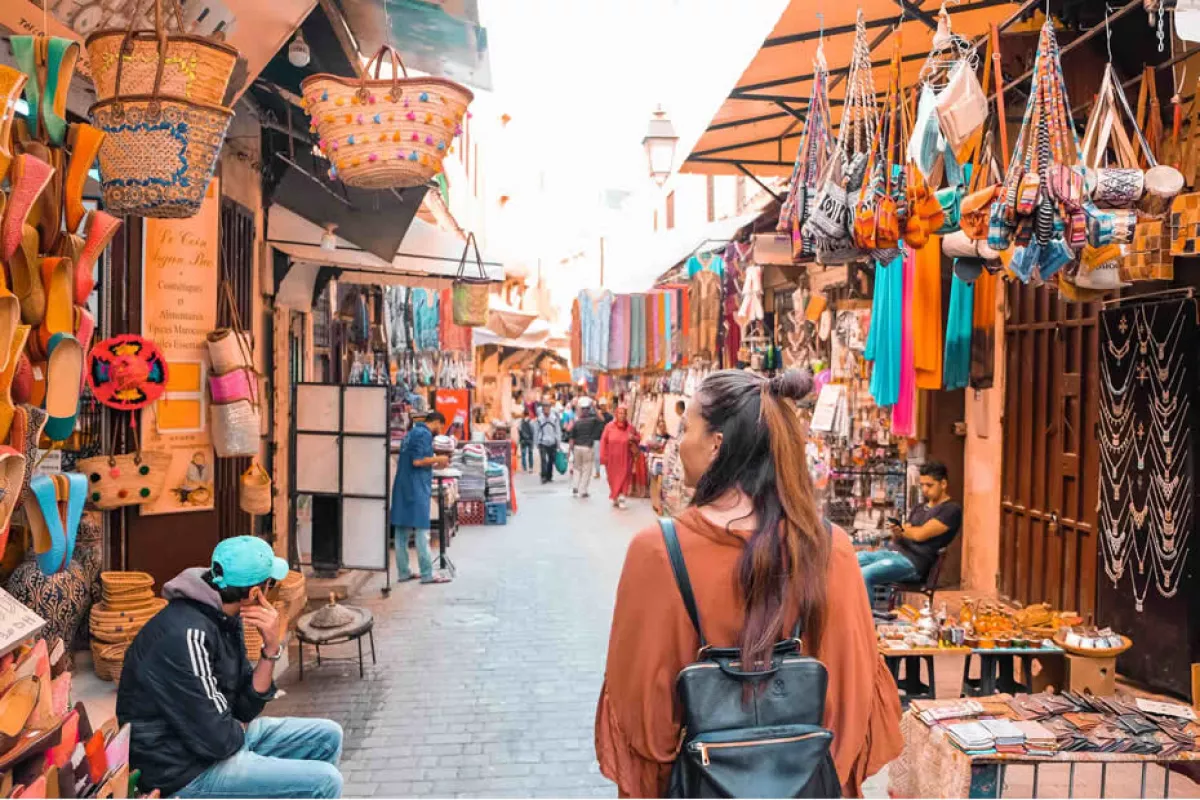
With a second night in Fes you have the late afternoon free. Drive up to the Merenid Tombs or the Borj Nord for the sunset over the whole medina, then eat in the riad. Fes cooking is the most refined in Morocco: try pastilla, the sweet-and-savoury pigeon or chicken pie dusted with cinnamon. Our guide to the Moroccan food you should try lists what to order where.
Day 6: Fes to the Sahara
The longest day, and one of the most varied. You climb into the Middle Atlas through Ifrane, a neat alpine-style town, and the cedar forest near Azrou, where Barbary macaques wait by the roadside. Lunch is usually in Midelt, between the Middle and High Atlas. The afternoon road follows the Ziz Valley, a ribbon of palm groves under red cliffs, and the land opens out into the pre-Sahara.
You reach Merzouga in the late afternoon, swap the vehicle for a camel and ride into the Erg Chebbi dunes for sunset. Dinner is in camp, with drums around the fire afterwards and, on a clear night, the Milky Way overhead.
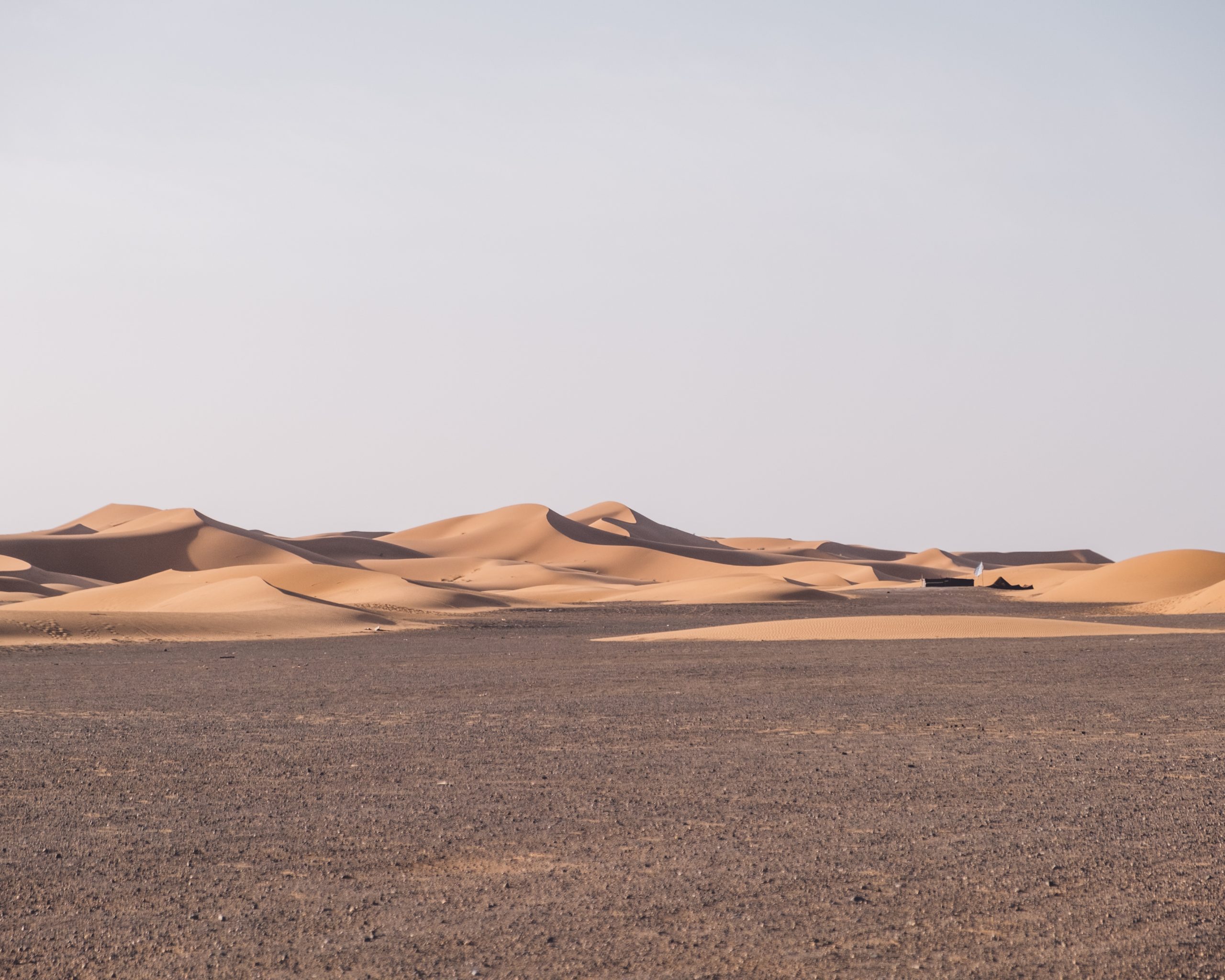
Local tip: pack a small overnight bag for the camp and leave the suitcase in the vehicle. From November to February, bring a warm layer and a hat: days are sunny, but desert nights can drop close to freezing. Our Morocco packing list covers the rest.
Day 7: Sunrise, Todgha Gorge and the Dades Valley
Climb a dune for sunrise, ride back to Merzouga for breakfast and a shower, then head west through Rissani, the old caravan town of the Tafilalet. Its souk is busiest on Sundays, Tuesdays and Thursdays, when you’ll find spice stalls and a donkey “parking lot” side by side.
After Tinghir, turn into the Todgha Gorge, where 300-metre limestone walls close to a few metres apart over a clear stream. It is a short, flat walk and a good leg-stretch. Then continue to the Dades Valley and sleep in a guesthouse facing the gorge. If you arrive with light left, drive up to the famous switchback road above Tamellalt for the classic photo.
Day 8: Kasbahs, Aït Ben Haddou and the High Atlas
Follow the “Road of a Thousand Kasbahs” through the rose valley and the palm groves of Skoura to Ouarzazate, home of Morocco’s film studios. Thirty kilometres on is Aït Ben Haddou, the fortified earthen village listed by UNESCO and used in dozens of films and series. Cross the river, climb through the ksar to the old granary at the top and look out over the valley.

The afternoon crosses the High Atlas over the Tizi n’Tichka pass (2,260 m), with hairpins, argan-wood stalls and Berber villages clinging to the slopes. You come down into Marrakech in the early evening. Snow can close the pass for a few hours in winter; your driver will know, and there is always a way round with patience.
Day 9: Marrakech
Your first full day in the Red City. Our suggested order, which avoids the worst of the crowds:
- 8:30–11:00: the Ben Youssef Madrasa (about 100 MAD) and the Bahia Palace (about 100 MAD), both best at opening time.
- 11:00–14:00: the souks between the madrasa and Jemaa el-Fna, with lunch on a rooftop. Agree prices before you buy, and don’t feel obliged to buy after mint tea.
- Afternoon: the Jardin Majorelle and the Yves Saint Laurent Museum (book timed tickets online a few days ahead), or the Saadian Tombs and the El Badi Palace ruins if you prefer history to gardens.
- Evening: Jemaa el-Fna at dusk, when the food stalls light their grills and the storytellers and musicians gather.
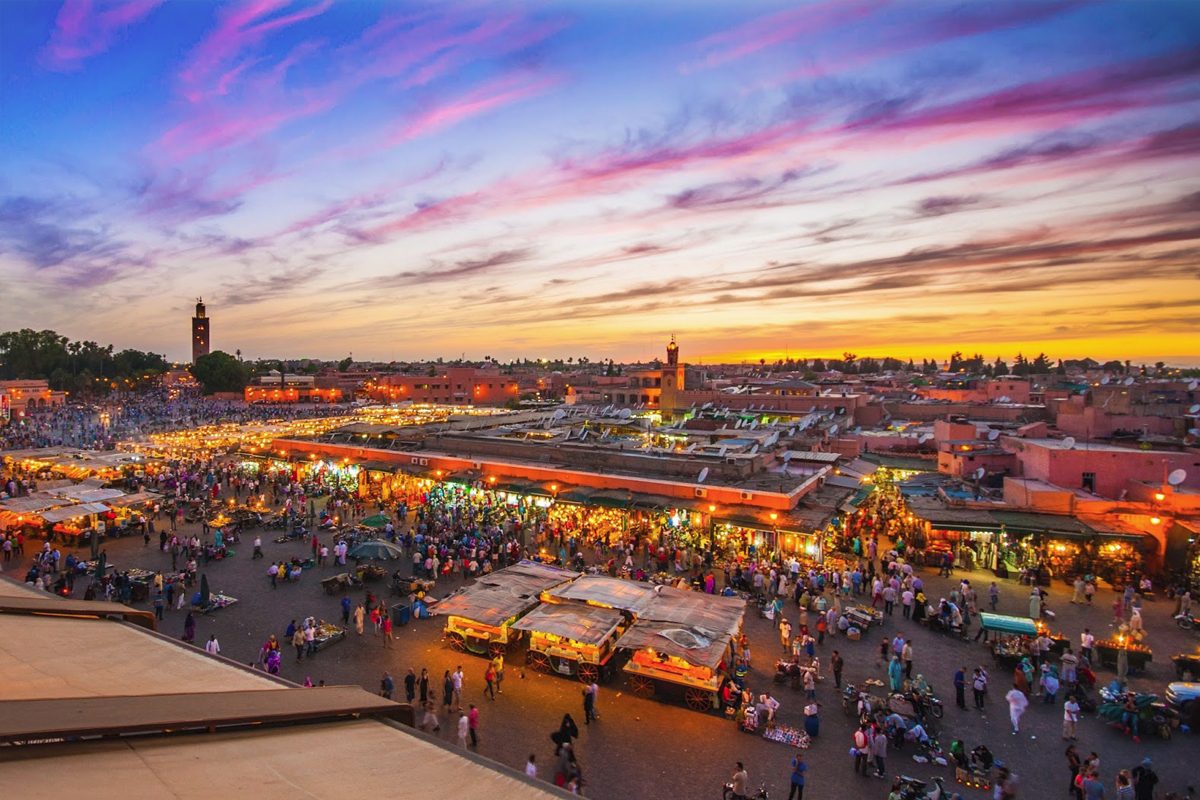
The medina is easier with someone who knows the shortcuts. Our Marrakech city tour with a local guide covers the palaces, souks and hidden courtyards in a day.
Day 10: High Atlas or Essaouira
The extra day is what turns a good trip into a relaxed one. Pick one:
Option A: Imlil and the High Atlas
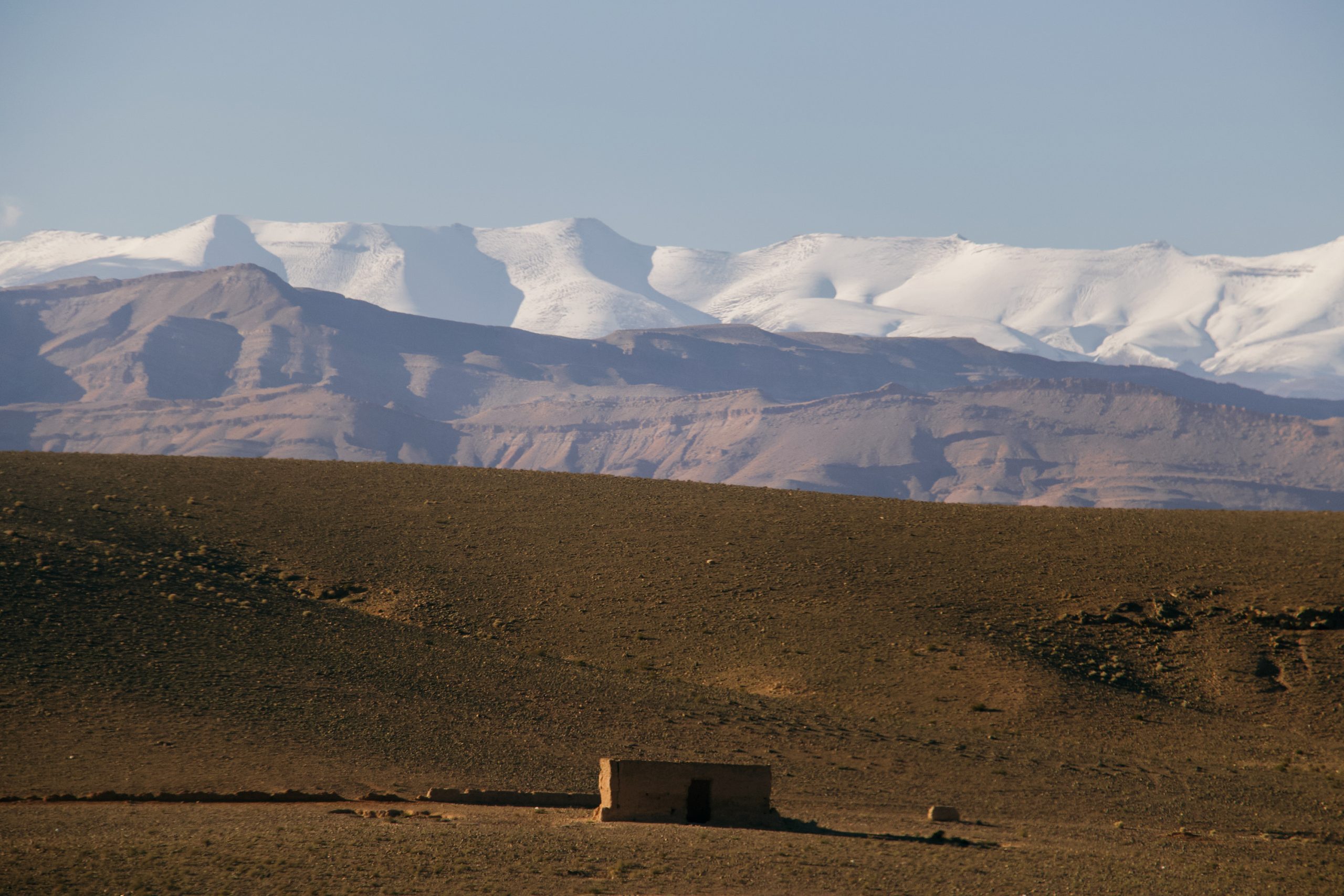
Imlil sits about 65 km south of Marrakech, roughly 1.5 hours by road, at the foot of Jebel Toubkal, North Africa’s highest peak (4,167 m). Walk through walnut groves and terraced fields to the Berber village of Aroumd, have lunch with a mountain family, and be back in Marrakech for dinner. It is the best contrast to the city you can get in a day. If one day in the mountains isn’t enough, our Atlas Mountains trek through Berber villages and valleys is built around it.
Option B: Essaouira on the Atlantic
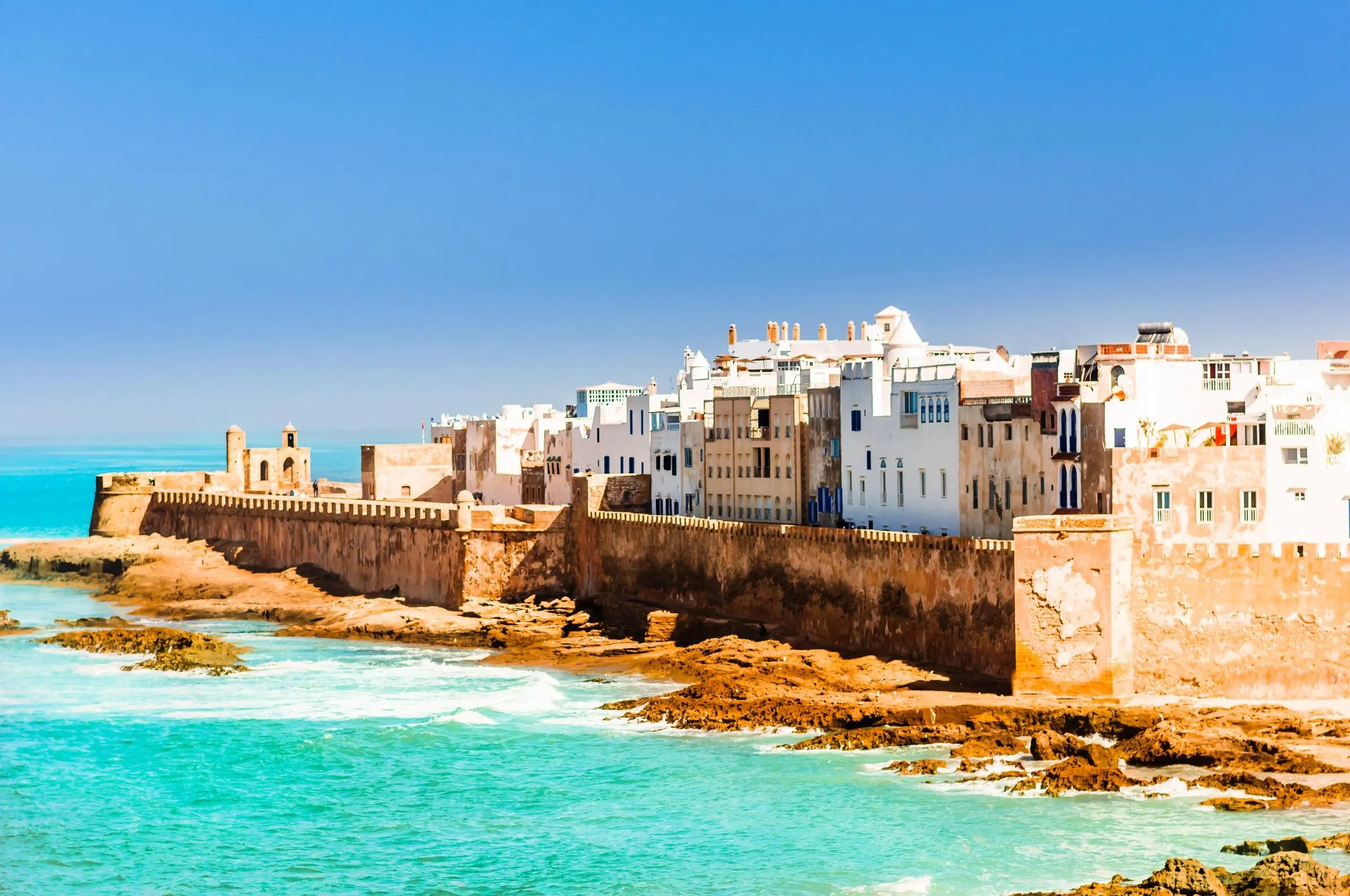
Essaouira is about 190 km west of Marrakech, 2.5–3 hours each way, past argan trees and goats famously climbing them. The walled port town has a fortified sea bastion, a working fishing harbour where you can choose grilled fish straight off the boats for lunch, and a breezy, laid-back medina. As a day trip it is long; if you can stretch to 11 days, sleep there one night. See our Essaouira destination guide.
Fly home from Marrakech on day 11.
Two alternative 10-day Morocco routes
The north-to-south route above is our favourite for first-timers, but it isn’t the only good way to spend ten days. These are the two variations travellers ask us for most:
| Classic: Casablanca to Marrakech | Marrakech loop | Slow south | |
|---|---|---|---|
| Route | Rabat, Chefchaouen, Fes, Merzouga, Dades, Marrakech | Marrakech, Atlas, 3-day desert loop, Essaouira | Marrakech, Atlas villages, Aït Ben Haddou, Dades, Merzouga (2 nights) |
| Sahara nights | 1 | 1 | 2 |
| Chefchaouen and Fes | Yes, both | No | No |
| Flights | In CMN (or TNG), out RAK | Return to RAK | Return to RAK |
| Best for | First-timers who want the full picture | Cheap return flights, beach finish | Hikers, photographers, repeat visitors |
Alternative 1: the Marrakech loop
If your flights are a return to Marrakech, build the trip from there. Days 1–2 in Marrakech; day 3 in the High Atlas; days 4–6 on a desert loop over the Tizi n’Tichka to Merzouga and back through the Dades and Aït Ben Haddou; days 7–9 in Essaouira; day 10 back to Marrakech for the flight. You miss Fes and Chefchaouen, but there is far less driving per day, and the coast at the end is a lovely way to unwind. Our Southern Morocco Discovery covers the desert loop, and the Sahara Desert Tours Morocco itinerary gives you more time in the dunes.
Alternative 2: the slow south
For travellers who have done the cities before, or who simply prefer landscapes to medinas: a night in an Atlas village, a night at Aït Ben Haddou instead of just a stop, the Dades and Todgha gorges with time to hike, and two nights around Merzouga so you can visit nomad families, the Gnawa village of Khamlia and the dunes at both sunrise and sunset. The Morocco Desert Tour and the High Atlas Mountains and our off-the-beaten-path tour of Morocco both lean this way.
Getting around: train, self-drive or a small-group tour?
- Train: excellent between Tangier, Rabat, Casablanca, Fes and Marrakech. The Al Boraq high-speed line runs Tangier–Casablanca in about 2 hours 10 minutes, and regular trains link Casablanca with Fes (about 3.5 hours) and Marrakech (about 3 hours). But there is no railway to Chefchaouen, the Sahara, the Dades Valley or the Atlas villages, which are half this itinerary.
- Self-drive: possible, but Fes–Merzouga and the Tichka pass are long days, parking near the medinas is a headache, and you’ll still need to book guides, camps and camels separately.
- Small-group tour: the easiest way to do the full route in ten days. The driver-guide handles the roads, the camel camp and the stops you would never find alone, and the cost of the vehicle, fuel and guide is shared across the group instead of paid by you alone.
Why a 10-day Morocco trip works so well in a small group
We see the same pattern every season. Couples and solo travellers plan this route independently, then realise that the desert section alone needs a 4×4, a driver for three days, a camp booking and a camel handler, and that hiring a private driver for ten days is the single biggest cost of the trip. Joining a small group solves both problems at once:
- One booking covers the hard parts: transport, riads and camps, guides in Fes and Marrakech, and the timing of every long drive.
- Shared costs: you split the vehicle and the driver-guide, which is what makes the north-to-south route affordable for a couple or a solo traveller.
- Company in the desert: dinner around the fire is better with new friends, and solo travellers especially tell us it was the highlight.
If you’d rather travel on your own dates or with family only, any of our group tours can be booked as a private trip instead.
Best time for 10 days in Morocco
The route works all year, but the season changes the experience. Our best month to visit Morocco guide has the detail; for this itinerary in particular:
- Spring (March–May): the best all-round season. Green Rif hills, almond and rose blossom in the south, comfortable desert nights.
- Autumn (late September–November): warm days, harvest season for dates in the Tafilalet, and fewer crowds than spring.
- Winter (December–February): clear, sunny days and snow on the Atlas, which is spectacular from the Tichka road, but cold nights in Chefchaouen, Fes and the desert. Riads are not always well heated, so pack layers.
- Summer (June–August): Fes and Marrakech often pass 38–40°C and the desert is hotter still. Chefchaouen and the coast are pleasant. Start early and rest in the afternoons.
- Ramadan (expected from around early February to early March in 2027): monuments keep shorter hours and some cafés close by day, but the evenings after iftar are some of the liveliest of the year.
How much does 10 days in Morocco cost?
It depends mostly on your hotels and how you travel, but these are the main items to budget for:
- Entrance fees: low. The Hassan II Mosque is the most expensive at 140 MAD; most palaces, madrasas and museums cost 100 MAD or less. Since 2025, tickets for many of Morocco’s state-run heritage sites can also be bought online.
- Meals: a tagine or couscous in a local restaurant costs far less than in Europe; rooftop and riad dinners in Marrakech and Fes cost more. Street food at Jemaa el-Fna is cheap and good if you choose busy stalls.
- Guides: a licensed local guide for a day in Fes or Marrakech is worth every dirham.
- Transport: the biggest variable. Trains are inexpensive; a private 4×4 and driver for the whole trip is the largest single cost, and it is the cost a small group shares.
For our group departures, see the dates and prices on each tour page below.
Practical tips for your 10-day trip
- Book open-jaw flights. Into Casablanca or Tangier, out of Marrakech, saves a full day.
- Stay inside the medinas in Chefchaouen, Fes and Marrakech. Riads are part of the experience.
- Carry cash. ATMs are easy in cities but rare between Midelt and the Dades Valley, and camps, small shops and tips are cash only.
- Stay alert in the medinas, not anxious. Our advice on staying safe in Morocco covers the usual tricks.
Do this 10-day route with Travel Link Morocco
Want the route without the logistics? These small-group tours follow this itinerary or one of its alternatives, with English-speaking guides, comfortable vehicles and hand-picked riads and desert camps:
- Ultimate Morocco Tour: the fullest version of this route, with Chefchaouen, the imperial cities, the Sahara and the coast. See dates and prices.
- The Highlights of Morocco Tour: Casablanca, Rabat, Fes, the Sahara and Marrakech. Add a day in Marrakech and the Atlas for a 10-day trip.
- The Authentic Morocco Tour: Culture and Traditions: for travellers who want more time with families, artisans and local food.
- Sahara Desert Tours Morocco: the Marrakech-based alternative with more time in the dunes.
Every tour runs as a small group on fixed departure dates, with a private option if you prefer to travel on your own.
See all Morocco group tours and dates
10-day Morocco itinerary: frequently asked questions
Can you see Chefchaouen and the Sahara in 10 days?
Yes, and that is the main reason to choose 10 days over 7. Do Chefchaouen first (two nights), then go south via Volubilis and Fes to Merzouga, and finish in Marrakech.
Should I start my Morocco trip in Marrakech or Casablanca?
Start wherever your flights are best. Casablanca or Tangier to Marrakech is the most logical north-to-south line and saves Marrakech for the end. If you have a return ticket to Marrakech, use the Marrakech loop instead.
How many days do you need in Marrakech?
Two full days is ideal: one for the medina, palaces and souks, and one for a day trip to the High Atlas, the Agafay desert or Essaouira.
Is it worth going to Fes if I’m visiting Marrakech?
Yes. They are very different: Fes is older, more traditional and more of a labyrinth, with the tanneries and the madrasas; Marrakech is livelier, with gardens, palaces and Jemaa el-Fna. On a 10-day trip you can and should see both.
Can I do a 10-day Morocco itinerary by public transport?
Partly. Trains connect Tangier, Rabat, Casablanca, Fes and Marrakech, and buses reach Chefchaouen, Merzouga and Essaouira. But connections are slow, and the stops in between (Volubilis, the gorges, Aït Ben Haddou) are hard to reach. Most travellers use a driver or join a group tour for the desert section at least.
What is the best month for 10 days in Morocco?
April, May, October and early November are the most comfortable for the full route. March and September are also very good. In winter, pack warm clothes for the north and the desert.
Is Morocco good for solo travellers on a 10-day trip?
Yes, and a small-group tour is the easiest way to do it: you share costs, have company in the desert and in the evenings, and a guide takes care of the logistics and the medina hassle.